Showing posts with label landmarks. Show all posts

28 September 2008

Old Singapore Quiz (3)


1. What is the address of this building? (Provide the number, road name and postal district.)

2. When was it built?

3. Who was its occupant (up till the early 1990s)?

4. Who is its current occupant?

5. When did the current occupant move in?

Note: I have "painted over" the square signboard above the main entrance to the building as I recently discovered that Icemoon has an uncanny ability to read very small signs. Now I hope that he can't read the plaques hanging in the corridor of the ground floor.

Update on 1 Oct 2008 - Answers to Old Singapore Quiz (3):

YG provided the most complete and correct answers in my blog. He got 4 out of 5 answers correct. His answer "1976" for when the building was built was incorrect. Before I give you the answers to the quiz, let's look at other photos I took of this building.


This is the unmistakable old gate of Institute of Dental Health (IDH) - the letters "IDH" appear 20 times on this gate. It is a good thing that the old gate was retained.

1. What is the address of this building? (Provide the number, road name and postal district.)
Ans: 10, Hyderabad Road (off Alexandra Road), Singapore 119579.

2. When was it built?
Ans: 1935.

3. Who was its occupant (up till the early 1990s)?
Ans: Institute of Dental Health.

4. Who is its current occupant?
Ans: S P Jain Center of Management

5. When did the current occupant move in?
Ans: Mar 2007.

I remember having had a few dental treatments done at the IDH in the late 1980s. It had an open concept, just like what this 1952 photo from National Archives of Singapore shows:


While waiting for my dreaded turn, I could hear the drilling sounds as well as the moans and groans coming from the patient in the adjacent chair. This only made me more nervous. No wonder I still dread going to the dentist till this day.

22 September 2008

Old Singapore Quiz (2)


1. What is the address of this building? (Provide the number, road name and postal district.)

2. Which company used to occupy this building?

3. When did the company move into the building?

4. What product did the company manufacture?

5. Name 3 brand names under which the product was marketed as.

Note: To make the quiz more challenging, I have deleted the background as well as the words on the building.

==================================================

Update on 24 Sep 2008 - Answers to Old Singapore Quiz (2)

Thanks for all your guesses. Most of you got the answers right. The most complete answers were provided by a reader named Eugene (please see this post). Well done, Eugene.

First, let's take a look at the original unedited photo:


Another photo taken from a different angle:


Below are photos of the same building from other sources. Here's one from National Archives Singapore (NAS) circa 1986:


Photo from Straits Times article dated 3 Jan 2007:


Here is an NAS image which shows a different building but with the same name. Anyone knows whether this building was located next to the present one? (I think the building has been demolished.)


There is even one of the same name in KL:


(Photo taken from this blog.)


Now for the answers to Old Singapore Quiz (2):

1. What is the address of this building? (Provide the number, road name and postal district.)

Ans
: 1177 Serangoon Road, Singapore 328231.


2. Which company used to occupy this building?

Ans
: National Aerated Water Co. Ltd.


3. When did the company move into the building?

Ans
: 1950s.


4. What product did the company manufacture?

Ans
: Soft drinks.


5. Name 3 brand names under which the product was marketed as.

Ans
: Sinalco, Kickapoo and Royal Crown (RC) Cola.


Here are some items related to the 3 brand names:


Old Sinalco symbol. You can see a partial image of this symbol in the NAS photo of the building above. Hence the building was also referred to as "Sinalco Building" by people of the older generation (like Peter).


A Sinalco bottle but not quite like the ones we used to see as kids. The surface of the old bottle was not so smooth, the Sinalco symbol was the old one shown earlier and the colour of the drink was more reddish and transparent.


An old Kickapoo advertisement, courtesy of the NAS. The Kickapoo glass bottle was dark green in colour and the picture on the bottle was printed in red words on a yellow background. (Hmm... I wonder why they called it "joy juice"?)


A Royal Crown Cola cap. This is a US version. I think ours looked different - the words "Royal Crown" were simply replaced by a stylised red "RC". However, I am so sorry that I can't find a sample to show you.

03 August 2008

Second 2nd-Shot - North Boat Quay In 1979 And Now

This is my second attempt at a "2nd-shot". (The first one is in the last post.) I hope that you find this effort a better one.

I have blogged about North Boat Quay here before (although at that time, I mistakenly called it Clarke Quay).

The following 2 photos show the same view of the Singapore River from Read Bridge. The first one is a video-grab from the movie Saint Jack which was filmed entirely in Singapore in 1979. (Chun See blogged about the movie here.)


As you can see, before the 80s, Singapore River had a lot of bumboats. These bumboats carried all sorts of goods - rice, flour, beans, copra, coffee, sugar and other dried goods. The goods would be unloaded from the bumboats typically by Chinese bare-bodied coolies. Each coolie usually had a towel hung around his neck for two purposes - one was to wipe off perspiration - unloading 100-kati sacks is certainly hard labour in Singapore's hot and humid weather. In fact the word "coolie" came from the Chinese words "ku li" (苦力) which mean "hard labour". Do you know what is the second purpose for the towel? (The answer will be revealed by next weekend.)

The bumboat would be moored next to the river bank. Two long planks, each about 10-foot long and 6-inch wide would be placed side-by-side in such a way that they span the gap between the bumboat and the river bank. The coolie would walk skillfully over these planks to get to the boat, lift a heavy sack onto his shoulder and then walk back over the planks to the bank again. You could see the planks bending and vibrating more when the coolie was carrying a heavy load.

In the early 80s, I used to stay overnight quite often at a very good friend's house which was one of the old houses you see on the left of the photo. During those days, one of the coffeeshops in the row of old houses on the left sold very good bak chor mee (minced pork mee).

Many things have changed since then. Comparing the 2 photos, it should be quite obvious to you that the old buildings have mostly been rebuilt. (So much for the conservation of our old buildings.) The fact is that our nation has undergone many changes in its landscape in just under 30 years. And it is not only on the banks of the Singapore River that you see renewal and development - you see them everywhere on this tiny island. But just from the second shot, you can tell that there are many more buildings in the background now. In 1979, you could only see Hill Street Police Station (now MITA Building) and Peninsula Hotel. Today, you could also see (from left) Raffles City Tower, Excelsior Hotel, Peninsula Plaza, Swissotel the Stamford (the tallest building in the photo and formerly known as Westin Stamford), The Treasury, 3 of Suntec City's 5 towers, among other buildings.

I am not going to do a review of Saint Jack as you can read very good reviews of the film on the Internet, one of them here.

Update on 5 Aug 2008:

Two of my readers seem confused over the names and locations of Clarke Quay and North Boat Quay. Perhaps a map of this area from my 1963 "Singapore Guide And Street Directory" will help clear up this confusion. (Unlike the buildings, the roads in this area and their names have largely remained unchanged till this day.)


The road in front of row of houses on the left of the photo is highlighted in yellow in the map - it is North Boat Quay. The camera was on Read Bridge and its lens was pointing in the direction of the red arrow. Clarke Quay is on the left hand side of the map while Boat Quay is on the other side of the Singapore River.

Update on 6 Aug 2008:


Here is another shot of the bumboats on the Singapore River. Judging from the view - Asia Insurance Building in the background - the photo was probably taken from Elgin Bridge in a south-easterly direction. It looks like an image on an old postcard. I got the image from a (mass?) email sent by a friend some time ago.

Hmm... maybe this will be my third 2nd-shot? :)

14 July 2008

Those Who Know Buy National

Singapore's National Day is around the corner and I am reminded of a tagline "Those Who Know Buy National". No, that's not a call for you to be patriotic during National Day. (Shouldn't you be patriotic every day?)

National was a very popular brand of electrical products in Singapore from the late 1950s till 2003 when the brand name was changed to Panasonic. Did you know that the tagline for National used to be "Those Who Know Buy National"? (Now it's "Panasonic Ideas For Life".)

The following information about the history of the National brand name was obtained from the company's website:
The company that started the National brand name in 1927 is Matsushita Electric, Japan. The brand became a very popular household name in Japan as well as in overseas markets. The new brand name Panasonic was first introduced in 1961 in the US where the National brand name had been registered by others and therefore, could not be used. The company started using the new brand name in Europe in 1979 and in other regions in the late 80s for products other than home appliances for which the National brand name continued to be used. The brand name for all home appliance products in Southeast Asia (including Singapore), the Middle East and China were changed to Panasonic by the end of March 2004. The National brand will, however, continue to be used in Japan where the brand was originally born.
I remember my family bought our first electric rice cooker in the 1960s. It was a National, of course, and it looked like this:


The rice cooker was the first National product to be introduced in Singapore in 1958. The inner pot was made of aluminium and was not teflon-coated. (Teflon probably had not been invented then.) There was also no inner lid but there was a 4-inch concave (or convex, if you look from inside) piece of glass in the centre of the lid. If you had nothing better to do, you could look through the glass and watch the rice bubbling beneath. (I don't know why we kids liked to do that then. Isn't it just about as exciting as watching paint dry?)

The lid had a plastic black-and-white handle. This handle cracked up quite often (maybe due to the heat) and had to be replaced. Luckily, you could find many neighbourhood shops selling spare handles and it was easy to replace the handle yourself.

There was also a prominent landmark along North Bridge Road, just behind Capitol Theatre where a car park now stands. I could see it from the balcony of my 4-storey SIT flat in Cheng Yan Place every night. From where I was looking, it was located just behind the Empress Hotel at the Middle Road and Victoria Street junction.


Circa 1950s - The steel structure was not erected yet


Circa 1960s - The prominent structure behind Capitol Theatre was up


An aerial view of the structure from Empress Place


A closer view of the structure in 1965- the tagline "Those Who Know Buy National" is visible. (Photo courtesy of Peter Chan.)

It was almost a 10-storey tall steel structure which was lighted up with red and white neon lights at night. (Hmm... was that by sheer coincidence? Those are also the colours of our national flag.) At night, the National red neon logo looked very prominent against the white vertical sweeping neon lights. It was indeed a powerful and attractive advertising structure.


The National signboard at night. What's not obvious from this photo are the vertical sweeping neon lights of the signboard which I remember very distinctly. (Photo courtesy of Peter Chan.)

Now I bet readers below 30 years' old didn't know that the steel structure once existed.

I can't remember this but according to my friend Peter Chan, at the bottom of the steel structure was a National showroom. Peter said that steel structure and showroom was torn down in the mid-1970s.

A National advertisement in the newspaper at that time using the same tagline. (Hagemeyer was the local agent for National products.) The 2 products in the picture - a transistor radio and an open-reel tape recorder - are now considered as collectible items, if not antiques.

Peter said that the showroom also exhibited black-and-white TVs. (TV was introduced in Singapore in 1963.) Every weekend, the showroom would be crowded - people turned up to watch free TV because not many could afford to buy one. The typical TV at that time looked like this one:


Our nation certainly has come a long way since then. Now our nationals not only watch Nationals but dozens of other TV brands as well. We even have a true national brand for electrical products now - Akira. The tagline of Akira to Singaporeans could well have been "Those who know buy national". But instead, its tagline is "Akira makes life better".


Happy 43rd National Day, Singapore!

06 July 2008

Another One Bites The Dust

I just read an article in yesterday.sg about the destruction of an old landmark in Tiong Bahru. (The original article appears on Tiong Bahru Estate blog and is about the destruction of the red gourd burner in Tiong Bahru estate.)

Oh soooo sad... sob, sob.

In the article, Noel laments:
"Sadly, there doesn’t seem to be any pictures of the red gourd burner before it was destroyed. Perhaps someone has an image that can be shared on yesterday.sg or the Tiong Bahru Estate Blog?"
Well, fret not, Noel. I have had the foresight of taking a photo of the burner in January last year. Here it is:


Another old Singapore landmark that will soon disappear is The New 7th Storey Hotel. (The word "new" in the hotel's name is actually quite a misnomer - the hotel is 55-year-old as it was built in 1953. Even the order "7th" is inaccurate - I will tell you why later.) It has just been announced that the hotel will make way for a Downtown Line MRT station. According to the Land Transport Authority, the owner and occupants of the hotel, who will have to move out of the building by end December, will receive "compensation pegged at market value". (Note, not "nostalgic value" hor.)

So you (not just Noel) better go take some good photos of the hotel before it disappears from our island forever. I have already done so. (Please see photos below.) And if someone asks me for the photos again, I am going to charge. :p


The hotel was the tallest building around that area at that time. I counted the number of storeys - there seems to be 8. Hmm... can you count again for me? According to the hotel's website here, it actually has 9 storeys. Oh dear, now we are short of one, unless you count the rooftop as well.


Ah okay, if you look at the backside (pardon the language), it indeed has 9 storeys.


And if you peep at the right side of the backside, a very exciting feature is revealed - a quaint and retro-looking spiral staircase!


The very inviting hotel entrance.


An even more inviting restaurant entrance. Hmm... does anyone know if Ban Leong & Co was the original owner of the hotel?


Inside the restaurant. Erm... why there were no diners present was because it was...


10.40 in the morning lah. (A clock frozen in time, just like the hotel. Haha.)


The very warm receptionist. (No, not that he's feeling warm - the hotel is air-conditioned.)


They are also computerised and even have BIG LCD screens that obscure faces.


The last surviving cage-lift in Singapore but it would soon be gone too.

Isn't the hotel cute? Instead of just taking photos, it would be even better if you could stay a few nights in the hotel. I bet you'll never ever have the chance again to have the same experience after this December.

Footnote about blog title:

Another One Bites The Dust is the title of a 1980 funk-rock hit song by British rock band Queen which you don't expect people of my age to know. But hey, I do. ;) You can refer to the song's lyrics here.

21 September 2005

Vanishing Scenes of Singapore - Part 1


If you read my previous posts, you will know that I like to reminisce. My next few posts will be about vanishing scenes in Singapore. An integral part of the ever-changing landscape in Singapore must be the renewal of its old buildings. As we are a small and young nation undergoing rapid development, many old buildings have to be torn down to make way for new ones. Some buildings are demolished for justifiable reasons while others have to go solely because of commercial considerations.

That's the protagonists' point of view. On the other hand, the antagonists would argue that it is precisely because Singapore is a small and young nation that its history is so short and hence its historical relics so precious and few. Therefore old buildings with unique architecture are invaluable artefacts which ought to be preserved. Thankfully, this job of deciding whether a building is justified to be preserved rather than demolished rests in the hands of Urban Redevelopment Authority (URA) of Singapore. It identifies and recommends buildings of historical, architectural and cultural merits for conservation.

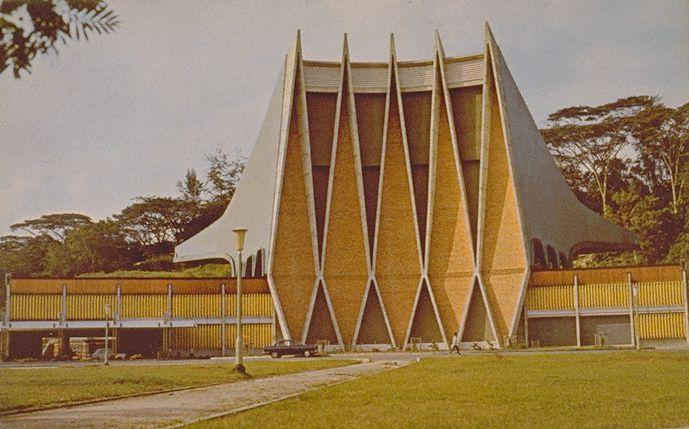
One good example is the National Theatre which used to stand near the junction of River Valley Road and Clemenceau Avenue. Officially opened on 8 August 1963, the theatre was built to commemorate the attainment of Singapore's self-government in 1959.

If this old memory of mine serves me right, in the late 1970s I attended a concert by the pop group America in the theatre. My recollection is that a resplendent fountain (by 1960s standard) stood at the front of the theatre. At the back, the distinctive feature of the building was its cantilever roof which provided spectators some form of shelter from the sun and the rain. It was however quite useless during heavy downpours as some rain could still get in. Being open at the back also meant that there was no air-con – a minus point which most 1960s folks didn't seem to mind. (There weren't many places with air-con then anyway. Even public buses were cooled by natural breezes from their open windows.) Besides, being a 'semi-open air' theatre somehow meant that people need not bother to dress up for the shows – they could come as they were, in their singlets, shorts and char kiaks (wooden clogs). The gate keepers (don't remember there were any ushers as it was free-seating), would never stop you because you were not properly attired so long as you did not over expose yourself. Yet another great advantage was that if the tickets for any show were sold out, you could still catch a free glimpse of the performance by standing on the hill slope (Fort Canning) which was overlooking the back of the theatre. It was even better if you had brought along a pair of binoculars.

When I think of the National Theatre, memories of the Van Kleef Aquarium just next to it comes flooding back. This aquarium was nowhere near the standard or the size of today's Underwater World in Sentosa but for a mere S$2 entrance fee, one could gawk at the 2 crocodiles (in an enclosure, of course) at the entrance before entering the aquarium to view the marine fishes. In contrast, today's entrance fee to Underwater World is more than S$10 and that's not counting the admission fee to Sentosa Island itself. (That's why people say that SENTOSA stands for So Expensive, Nothing TO See Anyway, haha.)

Then there was the River Valley swimming pool nearby too. I had a few swims there before it also had to make way for redevelopment. I guess it must be too expensive to maintain a swimming pool in the heart of the city. (This area is within Singapore Central Business District or CBD.) The land is just worth too much there, not to mention the water. Clarke Quay (see earlier post) was just opposite the swimming pool.

Many Singaporeans were deeply saddened when the National Theatre had to be demolished in 1986 due to structural reasons. (I think it was because the cantilever roof was structurally unstable, meaning that it might fall down anytime.) I was one of the sad people. Now we have the spanking new Esplanade Theatres on the Bay, also affectionately known to locals as 'the Durians' because of its thorny roof structure. (Actually the roof was designed that way to resemble a microphone – a supposedly clever and relevant reference to the activities to be staged inside the theatres.) But no matter how well-designed and acoustically-sound (pun intended) the Durians are, they could never evoke the nostalgia which many people have of the old National Theatre... sob, sob.

Update on 7 Aug 2008:


Here is another shot of the National Theatre. It is one of several other photos of old Singapore, probably from old postcards, that was emailed to me by a friend recently. This one has the resplendent fountain that I was talking about in this article. It was probably taken at a later date than the first one.