05 August 2013

Old Bottle Caps Of Singapore

One of my blog readers from Italy by the name of Massimo is a collector of old bottle caps. He has commented on my post Framroz's Aerated Waters as follows:
"I've just bought this cap
Framroz
and you can find other bottle caps from Singapore in my site at the page (here). If you want to use any photos you are free to do it.
Pearl
Seahorse
 Can you tell me something about the caps with the pearl and the one with the sea-horse?"
This is a challenge which I cannot take up. Not knowing the answers to Massimo's challenging questions myself, I emailed my heritage blogger friends, hoping that someone would know.

YG, who blogs here, said:
"Victor,

Could the 'Seahorse' bottle cap be for some Chinese cooling water sold at medical halls? No idea about the 'Pearl' cap.....don't know how to read the Chinese characters.

Rgds,
YG"

Massimo followed up on the matter by sending me an email:
"Hello Victor,

I’ve found very interesting the news about Framroz in your blog and it’s been amazing to see the Eastern Aerated Water building. Its cap is one that I specially like in my collection.

Thank for forwarding my question in your blog to your heritage friends. Now I better explain my request. I would like to know if the caps that I display in my Singapore page are all really from there, as well as the ones that are in Malaysia and Hong Kong.

I’m mainly interested in these caps:
Pearl
What is written on it? The upper side should be something like Pearl Ring, but the rest?


Seahorse
Do you know this kind of drink?


Snowman
Snowman. The text should say Snowman Aerated Water, but where was used?

Anyway, any other info about the Asian caps in my site will be welcome.

Greetings from Italy

Hi Massimo, thank you for your compliments about my blog post on Framroz. You can find more articles on soft drinks in my blog by clicking on the following links:

1. Ice Ball Man (2) dated 9 Jun 07;

2. Old Singapore Quiz (2) dated 22 Sep 08; and

3. Phoenix Aerated Waters dated 26 Oct 09.

Regarding your questions, looks like my blogger friends have not been able help much thus far. So I hope you don't mind that I am inviting comments from my blog readers via this post. I can answer one of your questions about the Chinese characters on the Pearl cap though. Yes, the characters on the top, read the traditional way from right to left mean "Pearl Ring". Those at the bottom simply mean "Registered Trademark" and hence I am afraid that they do not say much about the product in the bottle.

One more comment that I would like to make is that Singapore and Malaysia are geographically very close to each other. Hence, they share many of the brands of bottled products, especially when Singapore was part of Malaysia before 1963. Therefore, many of the bottle caps classified as belonging to Malaysia in your website were also found in Singapore at that time, namely RC, Sinalco, Coca Cola, Fanta, Mirinda, F&N Sarsi and Green Spot. And I would certainly not be surprised if the converse turns out to be also true.

Readers, if you can throw more light on Massimo's questions, please leave a comment here.

05 November 2012

Old Singapore Quiz (25) - Old Road in 1930s - Answers


24-year-old n.i.C first got the answer to the main question Q1 correct. Pastimes got 3 out of 4 answers correct (for Q1 to Q3). FL who put in a last-minute entry concurred with Pastimes. FL also remembered an air-conditioned cafe which he believed was called Les Bistro located near the piano shop. He had visited this cafe with his NS friends in the early 1970s.

Q1. What is the name of the road in the photo?
Ans: Orchard Road. (This is the end of the road which is near the Cathay Building.)

Q2. What is name of the building shown on the left side of the photo?
Ans: Amber Mansions.

Q3. From 1930s - 1970s, what goods was sold in the 2-storey building which is partially shown near the right edge of the photo?
Ans: Pianos.

Q4. What is the name of the road (where the premises of Peter's father was located) that runs to the right of the photo?
Ans: Dhoby Ghaut. (This road name is no longer in existence today but there is an MRT station with this name.)

More Information / Further Reading:

Comparing the old photo (top) with one that is taken recently (bottom), one realises the extent of transformation this area of Orchard Road has undergone in the last few decades. Only 3 or 4 buildings on the right of the old photo still remain today.


1963 street map of the area (top). The red arrow shows the direction in which the old photo was taken. Compare it with a 2007 street map of the area (bottom).

1. Similar photo circa 1928 taken from the book "Singapore - 500 Early Postcards".

The book was published by Editions Didier Millet in 2006 and was written by Cheah Jin Seng. The photo in the postcard provided the answers to Q2 and Q3.

2. Amber Mansions was built between 1922 and 1928 by renowned colonial architectural firm Swan & Maclaren and was one of Singapore's first shopping centres. Owned by Joseph Elias, a prominent Jewish businessman, it was demolished in 1984 to make way for the Dhoby Ghaut MRT station.

2a. My blogger friend Andy's post about his 1960s experience in performing at tea dances with the Silver Strings in the Celestial Room located on one of the upper floors of Amber Mansions.

2b. Daisy Flower Shop in Amber Mansions. Straits Times advertisement dated 3 Aug 1934 taken from National Library's newspaper archive. Note that Amber Mansions' address was 15 Orchard Road and the telephone number had only 4 digits then. (The SMA House, where Morris Motor Vehicle shop was located in the olden days and where MDIS is now, has the address of 14 Orchard Road.)

2c. National Library's article about Amber Mansions in its picture archive.

2d. Infopedia's article on Amber Mansions.


3. Photos from the National Archives showing Keller Piano Co Pte Ltd. The company, founded by the late Chiu Seck Joo in 1944, occupied the 2-storey building till the 1980s. Besides pianos, the company also sold other music instruments, music scores and records. (The company is now operating at 176 Orchard Road #04-01 Centrepoint, Singapore 238843.)

4. Aerial photo from the National Archives showing the same row of shophouses in the 2nd street level photo in Para 3 above.

Two of shophouses (circled red), at 2 to 4 Orchard Road, are likely to have been occupied by Radio Service Malaya Co where Peter Howard's father James Howard worked as a electrical/radio engineer in the 1930s.

James sailed from England for Singapore in 1934. Peter believed that his father worked for the British Government. During the years leading to World War I, his work involved checking the houses of people under suspicion by the British to see if their premises had transmitters capable of sending information to Japan. (Such interesting work! The modern-day term for this kind of work is called electronic countermeasure.)

29 October 2012

Old Singapore Quiz (25) - Old Road in 1930s


I received this email on 24 Oct 2012 from a UK gentleman by the name of Mr Peter Howard:
Hi Victor,

I stumbled across your blog when looking for old photos of Singapore. My father went to work in Singapore in the thirties before the Second World War, for the British government I believe.

I have found a post card, which I have attached [above], that he sent to my grandmother of [place name deleted by blog author] Singapore, and on the back he has written, "This photo is of [place name deleted by blog author] our premise (sic) are unfortunately around the corner on the right hand side of the picture."

Do you recognise this from the photograph and do you know the name of the street to which he refers?

While I am asking you all these questions, can you tell me if there is anyone or any organisation I can contact who would hold records of this period and enable me to find out more information concerning his stay in Singapore?

He loved living there and had to return to England when he contracted Yellow Fever.

I would really appreciate you sending me an email with any information you might have.

Best wishes
Peter Howard
I did a bit of research and found the answers to Peter's question quite easily. However, I suggested to Peter to put up his questions as an Old Singapore Quiz. I am confident that this quiz is easy and senior persons old-timers will have no problem providing the correct answers.

Q1.   What is the name of the road in the photo?

Q2.   What is name of the building shown on the left side of the photo?

Q3.   From 1930s - 1970s, what goods was sold in the 2-storey building which is partially shown near the right edge of the photo?

Q4.   What is the name of the road (where the premises of Peter's father was located) that runs to the right of the photo?

As usual, complete answers to the above quiz will be revealed in a week's time.

21 May 2012

Old Grange Road Bungalow (Circa 1920s) - Julian Davidson's Comments

One rewarding experience about having a blog is that you may get interesting comments long after a blog post has been written. Exactly this happened when Julian Davidson pleasantly surprised me recently with an email which provided fascinating insights about the old Grange Road bungalow, a post which I wrote almost 2 years ago on 6 June 2010.

For the uninitiated (like myself), Julian is an angmoh who spent his childhood years in Singapore back in the days when she was still part of British Malaya. In his book One for the Road and Other Stories: Recollections of Singapore & Malaya, Julian describes his experiences of bygone days, for example, the Cantonese amah who took care of him when he was young and the seafront in Singapore before it was reclaimed.

Julian's email

I don't know how to leave a posting on your blog – I'm a bit bodoh in that department – so I thought I'd contact you direct ...

Re-the Grange Road bungalow that a gentleman by the name of Sean was enquiring about in June 2010, the house was almost certainly built between 1910 and before the end of the First World War.

The architect would have been Scotsman David McLeod Craik – the little brick arches set in the basement or stereobate of the house were a signature feature of his, and though copied once or twice by other people are seldom seen outside his work. Craik came to Singapore to work for the Municipality as a Government Architect – he was one of the earliest (but not the first) members of the prestigious Royal Institute of British Architects (RIBA) to practice in Singapore. During his time with as a government employee he deigned the Jinrickshaw Station at the junction of Neil and Tanjong Pagar Roads.


He left the Municipality in 1907 and went into private practice during which time he designed three or four bungalows in the Grange Road area (including Rochalie Drive) which were all very similar to the house in Sean's photo: single storey affairs, but raised on a basement or stereobate with those brick-arches for ventilation, plus generous verandahs and half-timbered (black and white) gables.

Here's an illustration of one of them – designed for A. W. Cashin in 1913. I've compared Sean's photos with the plans that I have, but none of them seems to fit – the verandahs in my drawings all have slender timber columns (see below), rather than the robust brick piers that you see in Sean's photos.


In the 1913 Craik joined the British architectural firm of Swan & Maclaren, which was the leading architectural practice of its day. He volunteered for the Royal Engineers during the First World War – he was in his forties when war broke out – and was wounded in France in 1917. After the war he returned to Singapore and rejoined Swan & Maclaren. In 1921 Craik was posted to Penang to head their office in Georgetown and he lived there until he died in 1938.

That's all I can say for now; if Sean has any other photos of the house, I might be able to help.

Best wishes,

Julian

PS my father was also born in Singapore in 1920 but at the General Hospital!


Thank you so much for the email, Julian.


Over to you. Sean. 

28 November 2011

Selegie Integrated School - My Primary School Days (1)

How Selegie Integrated School Looks Like Today
In February this year, Sunday Times reporter Kon Xin Hua requested me for an email interview as the newspaper would be publishing an article on old buildings and Selegie Integrated School was one of them. Her questions and my answers are reproduced below:

Q1. What was the reason that saw you studying at Selegie Integrated School?

A1. Our family lived quite near to the school then. We were staying in Cheng Yan Place, a mere 15-minute leisurely stroll to the school which was less than one kilometre away. Of course, in those days, there was no such thing as priority for registration if you lived within one kilometre of the school. Even if there was, we would have no problem with it. As my family was not very financially well off, we could save on transportation costs if the school was nearby. The school was also brand new. I went to Primary One in 1963 which was year when the school was opened. (The then DPM Dr Toh Chin Chye officially opened the school on 19 Jan 1963.)

Dr Toh Chin Chye, Deputy Prime Minister and Assemblyman for Rochore Declaring the School Open on 19 Jan 1963 - Photo Courtesy of the National Archives
Q2. What were your initial thoughts on the 10-storey tall building?

A2. Having attended one or two years of kindergarten classes on the 2nd storey of a 4-storey SIT residential block in Prinsep Street, the 10-storey building certainly looked huge and imposing. (The SIT blocks are still in Prinsep Street. They have been conserved and possibly been converted into dormitories.) I had not seen such big lifts before. The only times when I took a lift was when my family visited my uncle's flat in a 9-storey SIT red-brick resident block (Blk 1) on Upper Pickering Street.

Q3. I'm sure there was more than one memorable feature of the school for you, would you be able to share with me a few features of the school that strike you the most? I read on your blog about the two canteens and lifts? :)

A3. Other than the 2 canteens, 2 lifts and the dental clinic which I mentioned in my blog, I remember part of the school ground was covered with coloured rectangular tiles of size about 1-foot by 2-foot. They were of yellow, red and green colours. I used to walk on them while trying to avoid all the lines in between the tiles. To me, it was a giant hopscotch.

Q4. What was life like as a student there? Any particularly striking events that happened in that school that come to mind?

A4. School life was quite routine. I remember one incident when due to a misunderstanding, a schoolmate punched me in the stomach. We were both brought to the principal's office. When the principal found out that I did not retaliate to the boy's attack, I was released. I didn't know what happened to the boy who punched me. There was another incident when a boy disturbed some female classmates and was punished in a unique way. The teacher put an unstrung badminton racket to rest at the neck of the boy and then pulled the racket back and forth. If this were to happen today and the boy's parents were to lodge a complaint to MOE, I am sure the teacher would be in serious trouble.

Q5. Do you recall the reason why they built a 10-storey high school?

A5. I don't recall the reason why they built a 10-storey high school. However, I believe that the land within the city area is scarce and expensive and hence the government had to fully utilise the land area by constructing a tall building.

Selegie Integrated School in 1963 - Photo Courtesy of the National Archives
Q6. What do you think of the building today, having been left abandoned for some time? (Is it a waste etc)

A6. I think it is a waste to leave it abandoned and in a derelict state. It should have been used to generate some revenue for the government's coffers, e.g renting it out to commercial schools or organisations.

Q7. What would you like to see happen to the building in the future?

A7. I would like to see the school converted to a hotel. This has been done for Pearl's Hill School which is now Hotel Re!. By the way, Pearl's Hill School was a 12-storey building and in 1971, it took over the unofficial title of the "tallest school in Singapore" from Selegie Integrated School.

Q8. Is it correct if I say you were fascinated by the big lifts in the school as you rarely took lifts unless you were visiting your uncle? Do you regularly take the lifts in your primary school? Which floor did you study on?

A8. Yes, I rarely took lifts then except when visiting my uncle. I was in the school for 6 years so I must have been on various floors before in different years. I think the classrooms I was in didn't go above 7th floor though. From the windows of the higher floors you could see quite far as there were not many tall buildings around to block the view then. I had to take the lifts several times a day - when reporting for school, going for and returning from recess breaks, going for and returning from PE classes, returning home as well as when I was "summoned" by the school dentist (which was quite often as my teeth were not very well-kept)

Q9. I would also like to ask you if you know anything about why the building was abandoned, and when it was abandoned?

A9. Sorry, I am not sure when Selegie School last operated in the building or when NAFA took over and when it abandoned it.

Further reading:

1. 4 Nov 2005 Vanishing Scenes of Singapore - Part 5 (My Primary School Days)

2. 5 Aug 2006 Hello Again 38 Years After "Eating Fishball"

3. 13 Aug 2006 Class of 1968 (Pr 6J of Selegie Integrated School)

29 May 2011

Modes Of Road Transportation In Singapore In The 1930s - The Rickshaw

Since my last two posts (here and here) were about a 1930s car in Singapore, do you know what were modes of transportation in the 1930s? I will be answering this question in this and the next few blog posts. I have posed the question as quizes because they would be rides in the park (pun intended), that is, they would have been too easy for you.

Besides, the answers are already given in this book which I co-wrote with Dr Tan Wee Kiat and Noel Hidalgo Tan. (On the website, you may read the entire book on page at a time by clicking on right link at the bottom of the page. In case you have missed it, I mentioned about the book here when it was published.)


The 5 pages in the book about the rickshaw, otherwise known as the jinrickshaw, are reproduced below:


Jinrickshaw (Rickshaw)

The word ‘jin-rick-shaw’ (or ’jinricksha’) literally means ‘man-power-carriage’. Later, the words ‘jinrickshaw’ and ‘jinricksha’ were simplified to ‘rickshaw’.

The rickshaw was first brought into Southeast Asia from Shanghai in 1880. Fares were cheap and the rickshaw’s popularity grew rapidly.

This photograph shows a rickshaw puller in normal day attire – long sleeves and straw hat to keep out the sun; shorts and unbuttoned shirt to keep cool; a towel around the neck for wiping off sweat and dust; and barefooted for a better feel of the road.


With the increasing number of rickshaws plying the roads in Singapore, a separate department was set up in 1899 to register and inspect the rickshaws. In 1903 the Jinrickshaw Station at the junction of Neil Road and Tanjong Pagar Road was built to house this rickshaw registry and inspection centre.

However, the activities that go on within the Jinrickshaw Station building nowadays are very different from those for which it was built.

The building currently houses a restaurant and nightclub with the sign “the one LCD KTV”.


At the Jinrickshaw Station there is a plaque describing the history of the jinrickshaw. Below is an excerpt from the plaque to give an idea of the fares paid by passengers. The wording on the plaque also indicates that many rickshaw pullers hoped to go back to China rather than settle here permanently.

“Early rickshaws were small, lightweight, hooded carts with large wheels, pulled by a single man. Hoods that were easily erected provided protection against the rain or strong sun, and, in some cases, prying eyes. A hood up in fair weather often meant that the passenger was a call girl or some character of disrepute. For three cents, one could go half a mile (0.8 km), or for 20 cents, have the rickshaw at one’s disposal for an hour. Most rickshaw pullers were coolies, who laboured in the hope of saving enough money to return to China after their sojourn. So popular was the rickshaw that it edged out its competitor, the steam tram.”


With their low wages, rickshaw pullers could afford only the cheapest of meals. One of their meals consisted of three (or more) bowls of plain yellow noodles cooked with green vegetables and dried shrimps.

As this dish was popular with the rickshaw pullers, it became known as ‘rickshaw noodles’.

It is still possible to find food stalls that sell rickshaw noodles. One such stall is located in the Maxwell Road Food Centre just across the road from the old Jinrickshaw Station. Note the words “RICKSHAW NOODLE” on the sign.


Many cities have banned the rickshaw. In Singapore the rickshaw was phased out in 1946 – 1947. In the Indian city of Calcutta (Kolkata) it was in use till 2006 when a law to ban rickshaws from its roads was passed. (TIME Magazine, 18 Dec 2006).

“WHEELS OF MISFORTUNE: Invented in Japan, rickshaws became a ubiquitous symbol of Western imperialism in the 19th century as native coolies hauled around their foreign masters in places as far afield as Shanghai and Zanzibar. But as they were steadily replaced by more efficient – and less demeaning – conveyances, the two-wheeled, human-powered carriages gradually disappeared from streets around the world.”


To round off this blog post, the undated article below was written by Crystal Chan, probably an SPH journalist.
Yesterday's Tales - People Power That Takes You Places


Rickshaws were once the last word in public transport around town - By Crystal Chan


Introduced here in 1880 from Japan, via Shanghai, the people-powered rickshaw was basically two parallel wheels onto which a carriage was mounted.


By the 1890s, the rickshaw trade was flourishing.


Other forms of public transport were evolving but were seldom as cheap or convenient: Trams or buses served mostly the city and cost 10 cents a ride.


In 1897, rickshaw pullers charged six cents per mile (1.6km). From 9pm to 5am, an extra cent was charged per half mile.


Unsurprisingly, the puller stayed poor. Throughout the 1920s and 1930s, records James Warren in Rickshaw Coolie: A People's History Of Singapore, average income was $1 a day.


Of this, he spent 30 cents on food, and between 45 and 50 cents on rickshaw rent.


Pullers from Fujian province wore cotton shirts, blue denims and straw hats, while those from Guangdong had hats with down-turned brims.


Rain or shine, they would pad about barefoot or in sandals made from old car tyres.


At night, they returned to Duxton Road and Duxton Hill in Tanjong Pagar, where they lived among opium and gambling dens and cheap brothels. The area was known as Che Zai Jie or Rickshaw Street.


From 1947, rickshaw pullers were retrained to operate trishaw - a rickshaw-bicycle hybrid. They had to pass tests set by the licensing authority.


The number of trishaws declined from the 1970s, and survivors now serve the tourists.


Timeline


1880: Rickshaw arrives from Japan.


1890s: Trade flourishes as they're cheap convenient and go everywhere. Trams and buses serve mostly the city.

1947: Pullers retrained to operate trishaws.

25 April 2011

Old Singapore Quiz (24) - Old Car - Answers

Hmm... what was my last blog post about? Sorry, it was so long ago that this old memory of mine could hardly remember.


Oh yes. It was about an old car quiz. Now the answers.

Answers to Quiz Questions:

Q1. What is the make and model of this car?

A1. Ford Y8. The emblem "Y8" on the following photo says it all.

Q2. When was this car manufactured?

A2. 1932 to 1937.


The car was probably imported from the United States as the metal holder for the number plate at the back (blacked out in the above photo) says "FLORIDA - LAND OF SUNSHINE".

Only Joshua Ng got part of the answer to the first question correct, i.e. it is a Ford. And he did it on 13 Mar 2011. Well done, Joshua.

Anonymous and YG both on 15 Mar 2011 gave the year 1937 which is in the correct range.

R. Burnett Baker's answer 1934 is also in the right range.

You can refer to more details on this Wikipedia link. The following passage is extracted from the link:

"For the first 14 months the original model with a short radiator grille was produced, this is known as the "short rad". After this in October 1933 the "long rad" model, with its longer radiator grille and front bumper with the characteristic dip was produced. By gradually improving production efficiency and by simplifying the body design the cost of a "Popular" Model Y was reduced to £100, making it the cheapest true 4-seater saloon ever, although most customers were persuaded to pay the extra needed for a less austere version."

The "front bumper dip" manifests itself as a slight "V" shape in the front bumper. (It is an original characteristic of the car and is certainly not caused by an accident or a careless knock.) You can see the "front bumper dip" in the photos of the car below:


Wikipedia photo of the Ford Y

Just imagine, the car is only powered by a 933 cc, 8 hp engine. Perhaps, the best part is that it costs only £100 in the 1930s, which is probably less than the equivalent of S$1,000 even when the pound is at its strongest. No such nonsense as COE (Certificate Of Entitlement) some more. Moreover, the price of petrol in those days was less than 20 old pence an imperial gallon. Based on the conversion rate of 1 imperial gallon = 4.55 litres and 240 old pence = £1, the price of petrol then was probably only a few cents per litre!

Oh, how I wish I was living in the 1930s! Do you?

06 March 2011

Old Singapore Quiz (24) - Old Car

Today, I was at an old part of Singapore. To be precise, I was walking along Dickson Road.

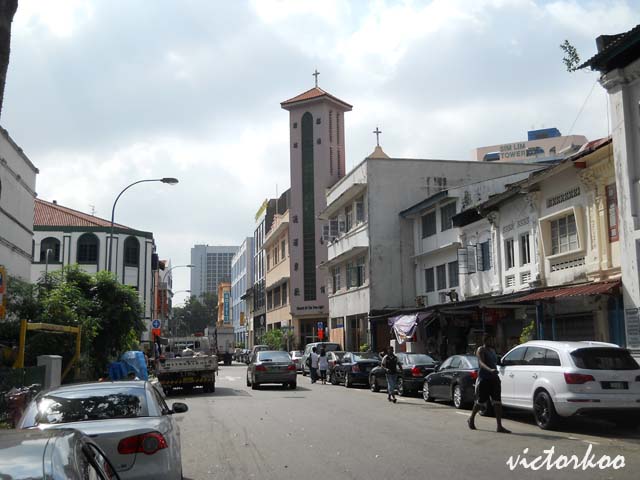
Dickson Road - The tower in the centre of the photo is the Church of the True Light
Most older Singaporeans know that this area has many shops that sell second-hand goods. It may be a misnomer to call them second-hand goods for some of the goods might have passed through many hands. Some of these "multiple-hand goods" are even sold from lorries by enterprising business people.


Suddenly, something old and deliciously chocolaty caught my eyes. No, it was not some mouldy Valentine's Day chocolates which were rejected by a disinterested lover. Neither was it for sale...

It was a chocolate car!


The car did not have a classic number plate but a new one that starts with "SJS". (I am quite sure that it would have easily qualified to be registered as a classic car as the rule only requires that the car be at least 35 years old. This car is definitely way, way older than that.)

The car is probably not a vintage that is first registered here but rather, one that is imported from elsewhere. Why do I say so? You see, the car is a "left-hand drive" while we all know that cars registered in Singapore are "right-hand drives".


And it was probably driven by someone who had just migrated here. Why? Because he left all the windows down (and windscreen up - something which is impossible to do for modern-day cars). I didn't check if the doors were locked though - they probably weren't. Although Singapore is generally considered a safe place with a low crime rate, the authorities do not recommend such a cavalier attitude.

Or maybe, the car owner thinks that any potential car thief will have a real problem disposing of the car? Anyway, who would want to buy a stolen car which turns head at every street corner? To add to the buyer's woes, he would likely also find it difficult to find the required spare parts to maintain the car in good running condition.

Quiz Questions

1. What is the make and model of this car?

2. When was this car manufactured?

06 February 2011

Old Singapore Quiz (23) - Old Petrol Station - Answers


Happy Chinese New Year to all of you. Sorry for having kept you waiting so long for the answers. Chun See, Peter, YG and Walter knew the answers but not all of them answered directly.

Answers to Quiz Questions:

Q1. What brand of petrol does this petrol station sell?
A1. Caltex

Q2. Where is this petrol station located? Give the road name.
A2. Woodlands Road. (The address is 337 Woodlands Road and the company name is Hup Soon & Co. It is located near Stagmont Ring.)


Notice that as if in keeping with the old world charm of the petrol station, the staff is using a traditional "sapu lidi" broom (made from the spines of coconut leaves) to sweep the floor. Also, the standalone diesel pump in the background seems to be deliberately left in a state of disrepair.


But nothing can compare with this old staff who appears to have aged gracefully together with this petrol station through all these years.

11 January 2011

Old Singapore Quiz (23) - Old Petrol Station


Chun See commented that my quizes are "a bit too tough" for him these days. So for his sake, I am giving an easy one this time. Should be a piece of cake. No clues needed.

The petrol station in the photo looks like a typical one in rural Malaysia, doesn't it? Well, it is not. Nowadays, I believe even some petrol stations in rural Malaysia look newer than that.

Would you believe that this "remnant from a bygone era" is in Singapore? It has got to be one of the oldest, if not the oldest petrol station in Singapore. No supermarket or convenience store in this outlet, only a car wash.

It probably dates back to the 1950s. Don't expect it to charge 1950s prices for petrol though. For cheap petrol, you still have to go further up north where the petrol stations are newer.

The petrol station badly needs a paint job and I have done just that. That is painting over the essential bits so that the quiz won't be too easy.

Quiz Questions:

1. What brand of petrol does this petrol station sell?

2. Where is this petrol station located? Give the road name.