14 July 2006

Remuneration for My First Few Jobs


My first two consecutive 'permanent' jobs in the late 1970s was as a clerk in foreign banks Banque Nationale de Paris (BNP) and Bank Negara Indonesia 1946 (BNI 46). The former was then located in Overseas Union House in Collyer Quay while the latter was situated in Malacca Street. [I think the former is now known as BNP Paribas, still located in Collyer Quay but on the opposite side of the road. BNI 46 is now known as PT Bank Negara Indonesia (Persero) Tbk, now situated in Cecil Street. Don't ask me what the words 'Paribas' and 'Persero' mean - they sound like French and Indonesian to me. Meanwhile, my name has remained unchanged for the last 50 years.]

The two banks were where I learnt my first words of French and Indonesian (not 4-letter ones). I didn't go very far with French but I could manage some Indonesian, maybe because it is very similar to our National Language. I also didn't go very far with either bank - I worked only about 3 months in each. You know why when I tell you that BNP was paying me $250. Mind you, that was per month and not per week. And it was in Sing dollars and certainly not French Francs (or Euros now). In addition, it was gross pay, i.e. before the deduction of CPF. After CPF took its monthly painful bite, my take-home pay was a measly $220+. Although the cost of living then was much lower than now, after paying for my lunch and public transport costs, I was lucky if I had any money left over. But it was just as well because the banks expected you to work lots of overtime. So much so that you didn't have much leisure time. So why do you need so much money for? I could almost hear the banks saying. "Why not let us keep the money safely... as our profits?"

One would have thought that banks, which have so much money, would at least pay their staff fairly, if not generously? But no, $250 was the standard starting pay for clerks. That amount was decreed by the Association of Banks then, I think. The purpose was probably to prevent poaching of clerks by one bank from another, I guess. Well to be fair, the banks paid a standard of 3 months' bonus. But could a clerk possibly survive till the end of the year to collect his bonus? Maybe, but it was difficult.

My friend Chris asked me why my money photo for this post had the words 'SAMPLE' on the dollar notes instead of the usual 'SPECIMEN'. I told him that I used 'SAMPLE' deliberately because I consider a $250 pay packet as only a sample of a real pay. Today, that amount couldn't even pay for my monthly petrol bill. So sad and fed up (with progress).

The irony of it all was that we were made to handle transactions that were thousands of times the amount of our monthly salaries. On paper, the figures seemed so unreal and surreal. I could fully understand why some employees were tempted. Very honestly speaking (literally), if I was not made of stronger moral fibre, I would have similarly succumbed too. If so, I would probably be in one of the following businesses today - baking, cooking, laundry or electrical and plumbing works - jobs for ex-offenders for which training is provided by SCORE (Singapore Corporation of Rehabilitative Enterprises).

When Philip, a senior clerk in BNP saw me leaving the office at 5 pm sharp, he blared out: "You've got to take advantage of the time difference between Singapore and Paris, you know?"

(I philiped flipped and interpreted what he was saying as: "The bank has to take advantage of cheap labour, you know?")

He also said: "You've got to work lots of overtime when you want to work in the bank!"

(And I thought that he was saying: "If you are unwilling to work overtime, you might as well resign!")

So resign I did. I went home and typed my resignation letter on my good old-fashioned manual typewriter right away. When BNI 46 offered me $50 more per month as meal allowance, I literally grabbed the offer. True, $50 meal allowance wasn't very much but at least I wouldn't go hungry with it.

Three months later, my present employer offered me $465 a month, which was quite comfortable in those days. (Imagine, if someone offers you almost double your pay today, wouldn't you have grabbed it too?) Since then, no one offered me a better pay and I remained loyal to my employer till this day.

I heard that NHB (National Heritage Board) is looking for a Corporate Communications Executive. Hmm... I wonder how much they are paying?

06 July 2006

British Legacies (2)


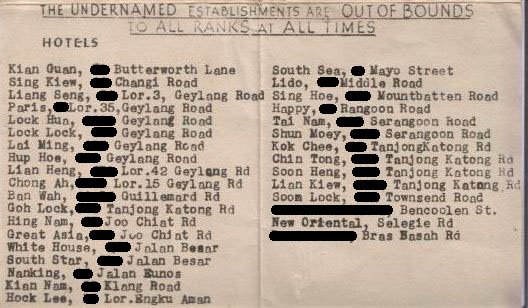
The establishments which were out-of-bounds to all ranks
at all times. House numbers and some details have
been masked out to protect existing property
business owners.

In my previous post titled British Legacies (1), there was a map showing the "out-of-bounds" areas to British military personnel in Singapore. In this post, Mr Peter Tan continues his story:

It must have come as a surprise to everybody as to why these restrictions existed. Did Singapore become the "Suzie Wong" of South East Asia? To side-track a bit, let's go back to the days of the Malayan Emergency (1948-1960) which saw the rising tide against imperialism and colonialism - two keywords often used by our country's founding fathers.

In order to provide manpower to contain the spread of Communism, Britain dispatched a number of regulars and National Servicemen to the region. National Service (NS)? Did I hear NS for the British? Indeed. NS was introduced in Britain in September 1939 by an Act of Parliament. At the end of WW2, the British Parliament decreed that all males in the British Isles, barring coal miners, between the age of 18 and 25 years had to do 18 months National Service in one of the three services: British Army (BA), Royal Navy (RN) or the Royal Air Force (RAF). This went up to 24 months because of the Korean War and the Malayan Emergency. Many chose an overseas posting for more pay and for the excitement of a foreign land. Many chose Singapore. When these single males arrived they were billeted in places like Nee Soon, Slim Barracks, Gloucester Barracks, Seletar, Kangaw, Terror, Selarang, Changi, Kranji, etc - names that should be very familiar to every SAF personnel.

Although there were the usual NAAFI or Union Jack Club that a young British male could go for that Tiger Beer (almost every British chap looked up to our Tiger, a sign of good international branding), there was always something mysterious about the tropics. Coming also at the time of the Maria Hertogh incident in 1956, it made sense for the British to impose strict discipline among the NS men. Since pay day was on a fortnightly basis, it was a time to leave camp and head for town. Many places soon understood that a typical "Johnny" was very generous when it came to fun and drinks.

Bars were not set-up by the triads but commercially-minded people who could make an offer few could resist. Many Chinese girls worked as bar girls, hoping for that better life - either more money or to marry a foreigner and sail to a distant land. There was very little a young Chinese girl or a woman with social-marital problems could do. Jobs were few to women in the 1950s and a good education for women was not well-received by many conservative families. So it made economical sense to consider the bar option.

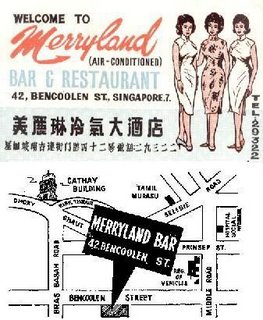
Many bars sprouted up in the Bencoolen Street and Bras Basah area. Business cards were used as the means to lure the British.


A business card of a bar at 42 Bencoolen St.
Note that the postal district there was only
a single digit "7" and the telephone number
had only 5 digits. Also, most illustrations then
were hand-drawn pictures or cartoons.

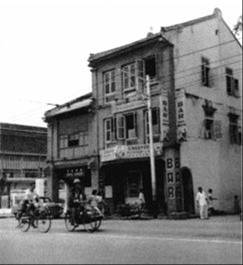
Coffeeshop at 42 Bencoolen Street today when
postal districts are in 6 digits and fixed line
telephone numbers have 8 digits.

Many "hotels" (a kinder term) bloomed all over Singapore. The punishment for any British soldier caught in a raid by the military authorities was the docking of half a month's pay. Though it had its initial impact, it was still not good enough. CROs (Company Routine Orders) and a card (see first photo) was handed to every new arrival to Singapore. The problem became less severe by 1963. By then, National Service was abolished, NS men demobilized and a new profile of regular British military personnel came to protect and bravely defend Singapore during the Indonesian Confrontation period.

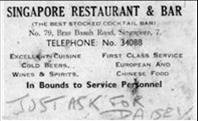
Back in the mid-60s when a "swaku" like me came to town to study at one of the finest English-medium educational institutions, we spent our Saturday evenings (after a game of rugby or scouting) exploring the dark corners of Bras Basah Road and Bencoolen Street. Not too far from our great institution was a bar next to the Bethesda Bras Basah Church (which I think could now be the Carlton Hotel):


The bar in Bras Basah Road (above) and its business
card (below). Note that "In Bounds" simply meant
not "out-of-bounds" and the handwritten suggestion
to "just ask for Daisey".

By 1967, the neon advertising board on the building facade of the bar looked like almost falling to the ground. Luckily it was suspended on one side by a thin wire. The paint work on the concrete pillar which had the word "BAR" had faded away. One day, we sneaked up the creaky stairs to the second level and saw a row of flashing coloured tungsten bulbs, a singer blasting into the microphone and a crowd of locals doing the "Twist". Suddenly a big burly bouncer approached us. We quickly made our exit after a small "Q&A" session. We found out about the history of the place but its heyday was over.

So where we now find our traditional "red light" areas or bars in places like Joo Chiat, East Coast Road, Jalan Besar, Tanjung Katong Road and Geylang, spare a thought and think back to "Yesterday Once More” when it all happened.


Further Readings:

1. Book Titled "Between Two Oceans : A Military History of Singapore from First Settlement to Final British Withdrawal" (Author: Malcolm H Murfett et al);

2. Straits Times article dated 3 Feb 2004 about ex-British airmen based here visiting old haunts and recalling the 1950s-60s and Changi Village bars. (There is a photo of one such bar in the PDF version here. There is a also mention of Stamford Cafe (see map in previous post) in the article;

3. This site contains many photographs and images contributed by people who lived in Singapore during the 1960s and early 70s and who were mostly children of British Armed forces personnel.

4. Unofficial site of Australia & New Zealand Forces; and

5. The RAF Seletar Association website.

05 July 2006

Fun Clip

In keeping with the unwritten theme of this blog, here's a fun clip. Click on the box below to play the video.


It is also my reply to Frannxis' fun clip here.

Hahaha.