Showing posts with label places. Show all posts

05 November 2012

Old Singapore Quiz (25) - Old Road in 1930s - Answers


24-year-old n.i.C first got the answer to the main question Q1 correct. Pastimes got 3 out of 4 answers correct (for Q1 to Q3). FL who put in a last-minute entry concurred with Pastimes. FL also remembered an air-conditioned cafe which he believed was called Les Bistro located near the piano shop. He had visited this cafe with his NS friends in the early 1970s.

Q1. What is the name of the road in the photo?
Ans: Orchard Road. (This is the end of the road which is near the Cathay Building.)

Q2. What is name of the building shown on the left side of the photo?
Ans: Amber Mansions.

Q3. From 1930s - 1970s, what goods was sold in the 2-storey building which is partially shown near the right edge of the photo?
Ans: Pianos.

Q4. What is the name of the road (where the premises of Peter's father was located) that runs to the right of the photo?
Ans: Dhoby Ghaut. (This road name is no longer in existence today but there is an MRT station with this name.)

More Information / Further Reading:

Comparing the old photo (top) with one that is taken recently (bottom), one realises the extent of transformation this area of Orchard Road has undergone in the last few decades. Only 3 or 4 buildings on the right of the old photo still remain today.


1963 street map of the area (top). The red arrow shows the direction in which the old photo was taken. Compare it with a 2007 street map of the area (bottom).

1. Similar photo circa 1928 taken from the book "Singapore - 500 Early Postcards".

The book was published by Editions Didier Millet in 2006 and was written by Cheah Jin Seng. The photo in the postcard provided the answers to Q2 and Q3.

2. Amber Mansions was built between 1922 and 1928 by renowned colonial architectural firm Swan & Maclaren and was one of Singapore's first shopping centres. Owned by Joseph Elias, a prominent Jewish businessman, it was demolished in 1984 to make way for the Dhoby Ghaut MRT station.

2a. My blogger friend Andy's post about his 1960s experience in performing at tea dances with the Silver Strings in the Celestial Room located on one of the upper floors of Amber Mansions.

2b. Daisy Flower Shop in Amber Mansions. Straits Times advertisement dated 3 Aug 1934 taken from National Library's newspaper archive. Note that Amber Mansions' address was 15 Orchard Road and the telephone number had only 4 digits then. (The SMA House, where Morris Motor Vehicle shop was located in the olden days and where MDIS is now, has the address of 14 Orchard Road.)

2c. National Library's article about Amber Mansions in its picture archive.

2d. Infopedia's article on Amber Mansions.


3. Photos from the National Archives showing Keller Piano Co Pte Ltd. The company, founded by the late Chiu Seck Joo in 1944, occupied the 2-storey building till the 1980s. Besides pianos, the company also sold other music instruments, music scores and records. (The company is now operating at 176 Orchard Road #04-01 Centrepoint, Singapore 238843.)

4. Aerial photo from the National Archives showing the same row of shophouses in the 2nd street level photo in Para 3 above.

Two of shophouses (circled red), at 2 to 4 Orchard Road, are likely to have been occupied by Radio Service Malaya Co where Peter Howard's father James Howard worked as a electrical/radio engineer in the 1930s.

James sailed from England for Singapore in 1934. Peter believed that his father worked for the British Government. During the years leading to World War I, his work involved checking the houses of people under suspicion by the British to see if their premises had transmitters capable of sending information to Japan. (Such interesting work! The modern-day term for this kind of work is called electronic countermeasure.)

29 October 2012

Old Singapore Quiz (25) - Old Road in 1930s


I received this email on 24 Oct 2012 from a UK gentleman by the name of Mr Peter Howard:
Hi Victor,

I stumbled across your blog when looking for old photos of Singapore. My father went to work in Singapore in the thirties before the Second World War, for the British government I believe.

I have found a post card, which I have attached [above], that he sent to my grandmother of [place name deleted by blog author] Singapore, and on the back he has written, "This photo is of [place name deleted by blog author] our premise (sic) are unfortunately around the corner on the right hand side of the picture."

Do you recognise this from the photograph and do you know the name of the street to which he refers?

While I am asking you all these questions, can you tell me if there is anyone or any organisation I can contact who would hold records of this period and enable me to find out more information concerning his stay in Singapore?

He loved living there and had to return to England when he contracted Yellow Fever.

I would really appreciate you sending me an email with any information you might have.

Best wishes
Peter Howard
I did a bit of research and found the answers to Peter's question quite easily. However, I suggested to Peter to put up his questions as an Old Singapore Quiz. I am confident that this quiz is easy and senior persons old-timers will have no problem providing the correct answers.

Q1.   What is the name of the road in the photo?

Q2.   What is name of the building shown on the left side of the photo?

Q3.   From 1930s - 1970s, what goods was sold in the 2-storey building which is partially shown near the right edge of the photo?

Q4.   What is the name of the road (where the premises of Peter's father was located) that runs to the right of the photo?

As usual, complete answers to the above quiz will be revealed in a week's time.

28 November 2011

Selegie Integrated School - My Primary School Days (1)

How Selegie Integrated School Looks Like Today
In February this year, Sunday Times reporter Kon Xin Hua requested me for an email interview as the newspaper would be publishing an article on old buildings and Selegie Integrated School was one of them. Her questions and my answers are reproduced below:

Q1. What was the reason that saw you studying at Selegie Integrated School?

A1. Our family lived quite near to the school then. We were staying in Cheng Yan Place, a mere 15-minute leisurely stroll to the school which was less than one kilometre away. Of course, in those days, there was no such thing as priority for registration if you lived within one kilometre of the school. Even if there was, we would have no problem with it. As my family was not very financially well off, we could save on transportation costs if the school was nearby. The school was also brand new. I went to Primary One in 1963 which was year when the school was opened. (The then DPM Dr Toh Chin Chye officially opened the school on 19 Jan 1963.)

Dr Toh Chin Chye, Deputy Prime Minister and Assemblyman for Rochore Declaring the School Open on 19 Jan 1963 - Photo Courtesy of the National Archives
Q2. What were your initial thoughts on the 10-storey tall building?

A2. Having attended one or two years of kindergarten classes on the 2nd storey of a 4-storey SIT residential block in Prinsep Street, the 10-storey building certainly looked huge and imposing. (The SIT blocks are still in Prinsep Street. They have been conserved and possibly been converted into dormitories.) I had not seen such big lifts before. The only times when I took a lift was when my family visited my uncle's flat in a 9-storey SIT red-brick resident block (Blk 1) on Upper Pickering Street.

Q3. I'm sure there was more than one memorable feature of the school for you, would you be able to share with me a few features of the school that strike you the most? I read on your blog about the two canteens and lifts? :)

A3. Other than the 2 canteens, 2 lifts and the dental clinic which I mentioned in my blog, I remember part of the school ground was covered with coloured rectangular tiles of size about 1-foot by 2-foot. They were of yellow, red and green colours. I used to walk on them while trying to avoid all the lines in between the tiles. To me, it was a giant hopscotch.

Q4. What was life like as a student there? Any particularly striking events that happened in that school that come to mind?

A4. School life was quite routine. I remember one incident when due to a misunderstanding, a schoolmate punched me in the stomach. We were both brought to the principal's office. When the principal found out that I did not retaliate to the boy's attack, I was released. I didn't know what happened to the boy who punched me. There was another incident when a boy disturbed some female classmates and was punished in a unique way. The teacher put an unstrung badminton racket to rest at the neck of the boy and then pulled the racket back and forth. If this were to happen today and the boy's parents were to lodge a complaint to MOE, I am sure the teacher would be in serious trouble.

Q5. Do you recall the reason why they built a 10-storey high school?

A5. I don't recall the reason why they built a 10-storey high school. However, I believe that the land within the city area is scarce and expensive and hence the government had to fully utilise the land area by constructing a tall building.

Selegie Integrated School in 1963 - Photo Courtesy of the National Archives
Q6. What do you think of the building today, having been left abandoned for some time? (Is it a waste etc)

A6. I think it is a waste to leave it abandoned and in a derelict state. It should have been used to generate some revenue for the government's coffers, e.g renting it out to commercial schools or organisations.

Q7. What would you like to see happen to the building in the future?

A7. I would like to see the school converted to a hotel. This has been done for Pearl's Hill School which is now Hotel Re!. By the way, Pearl's Hill School was a 12-storey building and in 1971, it took over the unofficial title of the "tallest school in Singapore" from Selegie Integrated School.

Q8. Is it correct if I say you were fascinated by the big lifts in the school as you rarely took lifts unless you were visiting your uncle? Do you regularly take the lifts in your primary school? Which floor did you study on?

A8. Yes, I rarely took lifts then except when visiting my uncle. I was in the school for 6 years so I must have been on various floors before in different years. I think the classrooms I was in didn't go above 7th floor though. From the windows of the higher floors you could see quite far as there were not many tall buildings around to block the view then. I had to take the lifts several times a day - when reporting for school, going for and returning from recess breaks, going for and returning from PE classes, returning home as well as when I was "summoned" by the school dentist (which was quite often as my teeth were not very well-kept)

Q9. I would also like to ask you if you know anything about why the building was abandoned, and when it was abandoned?

A9. Sorry, I am not sure when Selegie School last operated in the building or when NAFA took over and when it abandoned it.

Further reading:

1. 4 Nov 2005 Vanishing Scenes of Singapore - Part 5 (My Primary School Days)

2. 5 Aug 2006 Hello Again 38 Years After "Eating Fishball"

3. 13 Aug 2006 Class of 1968 (Pr 6J of Selegie Integrated School)

06 February 2011

Old Singapore Quiz (23) - Old Petrol Station - Answers


Happy Chinese New Year to all of you. Sorry for having kept you waiting so long for the answers. Chun See, Peter, YG and Walter knew the answers but not all of them answered directly.

Answers to Quiz Questions:

Q1. What brand of petrol does this petrol station sell?
A1. Caltex

Q2. Where is this petrol station located? Give the road name.
A2. Woodlands Road. (The address is 337 Woodlands Road and the company name is Hup Soon & Co. It is located near Stagmont Ring.)


Notice that as if in keeping with the old world charm of the petrol station, the staff is using a traditional "sapu lidi" broom (made from the spines of coconut leaves) to sweep the floor. Also, the standalone diesel pump in the background seems to be deliberately left in a state of disrepair.


But nothing can compare with this old staff who appears to have aged gracefully together with this petrol station through all these years.

11 January 2011

Old Singapore Quiz (23) - Old Petrol Station


Chun See commented that my quizes are "a bit too tough" for him these days. So for his sake, I am giving an easy one this time. Should be a piece of cake. No clues needed.

The petrol station in the photo looks like a typical one in rural Malaysia, doesn't it? Well, it is not. Nowadays, I believe even some petrol stations in rural Malaysia look newer than that.

Would you believe that this "remnant from a bygone era" is in Singapore? It has got to be one of the oldest, if not the oldest petrol station in Singapore. No supermarket or convenience store in this outlet, only a car wash.

It probably dates back to the 1950s. Don't expect it to charge 1950s prices for petrol though. For cheap petrol, you still have to go further up north where the petrol stations are newer.

The petrol station badly needs a paint job and I have done just that. That is painting over the essential bits so that the quiz won't be too easy.

Quiz Questions:

1. What brand of petrol does this petrol station sell?

2. Where is this petrol station located? Give the road name.

03 January 2011

Old Singapore Quiz (22) - Old Building - Answer


Nobody gave the correct answer for this quiz although YG did make an intelligent guess, as always, by saying that the building must be near my place of work. I don't think the quiz was too difficult but rather, there seems to be very few visitors to this place - Labrador Villa Road in Labrador Park and hence not many people know what it has to offer. Why do I say that? Well, I visited Labrador Park on the morning of 29 Dec 10, a Saturday and there was not a single soul in sight!


Almost all the facilities in the park were closed. They include the old building which, according to a location map in the vicinity, was originally designated a boutique hotel. I do not know whether the hotel business actually did materialise or not.


Other facilities that were closed include:


The secret tunnels.


The tunnels were "rediscovered" only in 2001 and officially opened by Minister for National Development Mr Mah Bow Tan not too long ago in March 2005.

Now they are "closed for maintenance".


The Villa Raintree Resort and Spa, which used to house the Pasir Panjang Boys' Hostel from 1980s till the early 1990s and then Breakthrough Missions till the early 2000s.


The creepers on its signboard look creepy.


The Olive Ristorante.


Even the toilets were closed. And definitely not for cleaning.


This statue in Labrador Park seems to be on the constant lookout for the precious and elusive visitor.

Considering the dearth of visitors, why do you think Labrador Park is now undergoing "maintenance"? Surely cannot be due to wear-and-tear because of heavy human traffic, right? And how come the supposedly "maintenance" does not have an expected completion date? Like Mandai Orchid Garden which "has been losing money from Day 1", according to its owner Mr Heah Hock Heng, I believe Labrador Park is suffering the same fate. Only difference is that Labrador Park is losing Government's, or more rightfully, taxpayers' money. Mr Heah continues to operate the Mandai Orchid Garden at a loss because of his passion for orchids. However, the same cannot be said for Labrador Park visitors. I don't think visitors are passionate enough about history and heritage to be willing to fork out $8.60 just to explore the secret tunnels at the park. Thus, the tunnels are likely to remain secret... or be "closed for maintenance" indefinitely.


What do you think?

27 December 2010

Old Singapore Quiz (22) - Old Building


Just like Icemoon who gave an Old Building Quiz before going on holiday, I will do the same. That is, give an Old Building Quiz, not go on holiday. So the clue for this quiz is a photo which I took in August 2009 of an old dilapidated building - one that would make an ideal backdrop for a sequel to a movie like Haunted Changi. I don't know how this building looks like today as I have not visited it since then.

Quiz Question:

Where is the location of this building?

20 December 2010

Old Singapore Quiz (21) - Another Pair Of Old Cannons Again - Answer


The two old cannons are located inside Changi Naval Base. Since they are sited near the sea, you should be able to see it if you pass by on a vessel. However, I was not in the sea but on land. To be precise, I was on the grounds of the Navy Museum next door which is not a restricted area.


Nobody got the answer to the location correct although YG did come up with a good guess, i.e. Cliff House at Bukit Chermin Road.

Peter Stubbs was probably right when he said that the cannons looked very much like 68-Pounder Smoothbore cannons. Compare the cannons with the one in the photo below which is reproduced from the Wikipedia link on the 68-pounder gun:


The following passage of the 68-pounder gun is extracted from the Wikipedia link:
The 68-pounder cannon was an artillery piece designed and used by the British Armed Forces in the mid-19th century. The cannon was a smoothbore muzzle-loading weapon that weighed 95 long cwt (4,800 kg) and fired projectiles of 68 lb (31 kg). Colonel William Dundas designed the gun in 1846 and it was cast the following year. It entered service with the Royal Artillery and the Royal Navy and saw active service with both arms during the Crimean War. Over 2,000 were made and it gained a reputation as the finest smoothbore cannon ever made.


The gun was produced at a time when new rifled and breech loading guns were beginning to make their mark on artillery. At first the 68-pounder's reliability and power meant that it was retained even on new warships such as HMS Warrior, but eventually new rifled muzzle loaders made all smoothbore muzzle-loading guns obsolete. However, the large surplus stocks of 68-pounders were given new life when converted to take rifled projectiles; the cannon remained in service and was not declared obsolete until 1921.

07 December 2010

Old Singapore Quiz (21) - Another Pair Of Old Cannons Again


As promised, this post is about another pair of old cannons again. However, this time, I didn't manage to get near enough to examine the cannons up close. The above photo was as close as the 3x optical zoom lens of my point-and-shoot camera could take me. So that is a clue, I hope. Nevertheless, you could see the cannon balls in front of the cannons. There are also 2 stick-like objects in front of the one of the cannons.

I have also removed the background of the photo, lest some people could identify the building behind instead of the old cannons. However, I have not erased the foreground as there are no ketapang leaves on it. What I can tell you is that the old cannons are near the sea. In fact, most cannons are located near the sea, as I have noticed. With Singapore's small size, there is certainly a physical limit as to how far inland you can site the cannons.

I must admit that I don't know the history of these cannons. So there is only one question is for this quiz for which I know the answer, and that is:

Q1. Where are the cannons located?

Another two questions which perhaps only Peter Stubbs could answer are as follows:

Q2. Are these cannons replicas or originals?

Q3. What is the history of these cannons?

As usual, the answer to Q1 will be revealed in a week's time. Happy guessing!

29 November 2010

Old Singapore Quiz (20) - Yet Another Old Cannon - Answers


Peter Stubbs got all the answers correct although it is quite obvious that both YG and Icemoon knew the answers too.


From Peter Stubb's detailed and informative comments, you could tell that he is an expert on the subject of guns, batteries and cannons used in World War II.

British gunners cleaning the gun barrel (IWM)
Publicity photo from WWII British War Office, showing off impressive size of Monster Guns (IWM)

The replica at Cosford Road, minus the "publicity models"
Here are the answers to the quiz:


Q1. The cannon in the above photo is a replica. Where is it sited? (Give the road name.)
A1. Cosford Road

Q2. How many such guns were there orginally near this location and what were they collectively called?
A2. Three guns and they were called the Johore Battery.

Q3. How many such guns were there in Singapore at that time?
A3. Five.

Q4. What was the diameter of the shell (in inches) that the gun fired?
A4. 15 inches.

The passage below is reproduced from the National Heritage Board's marker at the Cosford Road site.

Johore Battery

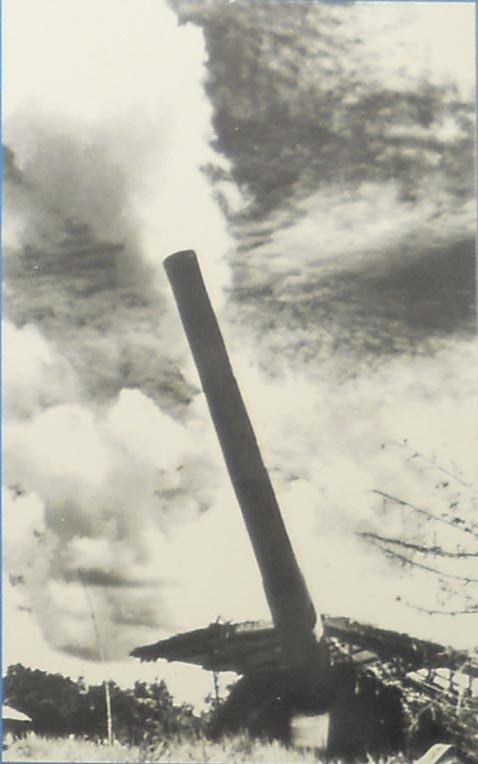
A close-up view of one of the "monster guns", 14 November 1941
A close-up view of the replica 69 years later - 15 November 2010
The Johore Battery comprised three guns. They were part of a group of twenty nine large coastal guns installed in Singapore in the 1930s.

The Johore Battery's three weapons were among Singapore's largest coastal guns. They were known as 15-inch guns, because 15 inches (38 cm) was the diameter of the shell they fired. Their gun barrels were 16.5 metres long and the shells stood 1.5 metres high. The guns were capable of hurling these shells at battleships over twenty miles away.

[From left to right]: General Sir Archibald Wavell accompanying the C.F.D. Brigadier Curtis and the General Officer Commanding Singapore Fortress, Major-General Keith Simmons, touring Singapore's defences, c. 1941
They were originally called "monster guns" when tested in England in 1934, before being sent to Singapore. When World War II started, there were only seven of these defending the coasts of the British Empire. Two were near Dover in England, and five in Singapore. Besides the Johore Battery, Singapore also had two 15-inch guns at Buona Vista Battery. They were located at the junction of Ulu Pandan and Clementi Roads, in the West of the island.

Gunners "pulling through" the barrel of a "monster gun" after firing, c. 1941
Each of Johore's Battery's guns had its own ammunition bunker. These were about 500 metres apart, arranged in a line that stretched from the present site onto what are now the runways of Changi Airport. Though these guns were originally intended to stop an attack from the sea, two of Johore Battery's guns could turn around and fire to the rear, towards Johor Bahru. The third, the one located at this site, could only fire out to sea.

One of the "monster guns" ready to "roar", 15 November 1941
From 5th to 12th February 1942, the two guns of the Johore Battery that could turn around fired landward in Singapore's defence. They shelled Japanese infantry positions from Johor Bahru, just across the Causeway, eastwards to the area North of Tanjong Punggol. They also joined in the battles for Bukit Timah Road and Pasir Panjang. The guns of Johore Battery fired 194 rounds before their demolition by the British on the night of 12th February. This demolition, and the postwar upgrading of Changi aerodrome, means all the remains are the underground tunnels on this site, which once housed ammunition and power plants.